Whole-body grasp generation
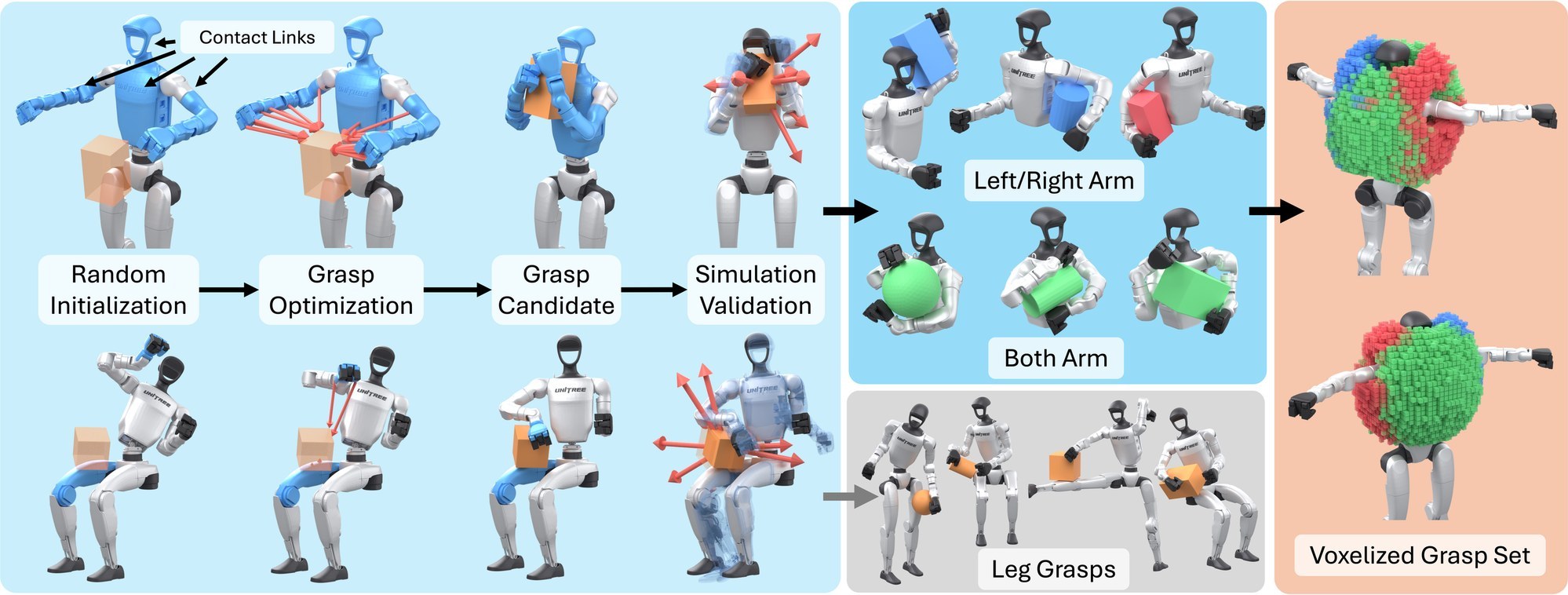
Energy-based optimization and simulation filtering produce the arm-and-torso grasp cache used for training.
Try out interactive whole-body dexterous experts!
Energy-based optimization and simulation filtering produce the arm-and-torso grasp cache used for training.
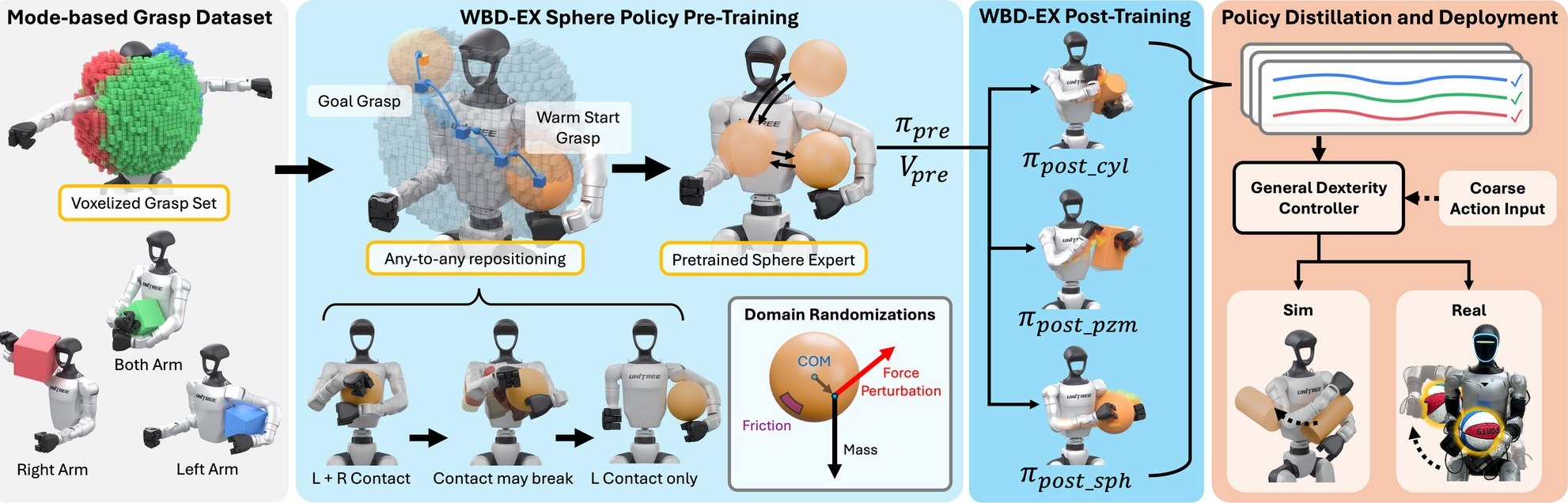
Reinforcement-learning experts learn to reposition an object and settle it in a left-arm, both-arm or right-arm hold, using goals sampled from the grasp cache.
The experts are distilled into one deployable policy that transfers zero-shot to a real Unitree G1 and is steered interactively by a teleoperator.
Generate whole-body grasps, train experts to move objects between them, then distill the experts into one controller.
Grasps are optimized from chosen contact links (blue), then kept only if they survive perturbations in simulation.
Experts start from cached grasps and learn to move objects toward sampled positions in left-arm, both-arm or right-arm holds. Intermediate goals connect the current position to a farther goal, allowing sliding and rolling across the torso.
We add noise to expert commands and compare direct execution with WBD refinement. The guidance weight controls how strongly motion generation follows the coarse command.
An Xsens motion capture suit provides coarse motion references. WBD refines the arm targets; a separate controller handles lower-body motion and balance. GMR (General Motion Retargeting) directly retargets the operator's motion; SONIC is a generalist whole-body controller.
SONIC
GMR
WBD (ours)
Shoulder tap
Underarm stow
| Task | Object | Controller | Region reached ↑ | Full round trip ↑ | Time to region (s) ↓ | Total time (s) ↓ |
|---|---|---|---|---|---|---|
| Shoulder tap | Ball | SONIC | 2/10 | 0/10 | 15.2 | — |
| GMR | 3/10 | 1/10 | 26.0 | 30.1 | ||
| WBD | 10/10 | 9/10 | 7.7 | 17.3 | ||
| Box | SONIC | 2/10 | 2/10 | 15.9 | 24.9 | |
| GMR | 6/10 | 4/10 | 8.0 | 8.5 | ||
| WBD | 10/10 | 10/10 | 4.1 | 6.3 | ||
| Underarm stow | Ball | SONIC | 1/10 | 0/10 | 28.0 | — |
| GMR | 4/10 | 2/10 | 31.5 | 49.8 | ||
| WBD | 10/10 | 9/10 | 10.6 | 26.2 | ||
| Box | SONIC | 2/10 | 0/10 | 26.1 | — | |
| GMR | 2/10 | 1/10 | 9.3 | 17.8 | ||
| WBD | 10/10 | 10/10 | 8.6 | 13.0 |
10 trials per controller, task and object. Times are averaged over successful trials.
| Controller (10 trials each) | Pick ↑ | Stow ↑ | Carry ↑ | Un-stow ↑ | Place ↑ |
|---|---|---|---|---|---|
| SONIC | 10/10 | 0/10 | 0/10 | 0/10 | 0/10 |
| GMR | 10/10 | 3/10 | 2/10 | 1/10 | 1/10 |
| WBD | 10/10 | 9/10 | 9/10 | 9/10 | 7/10 |